Designing a grid overlay based on longitudes and latitudes
An answer to this question on Stack Overflow.
Question
I'm trying to figure out the best way to approach the following:
Say I have a flat representation of the earth. I would like to create a grid that overlays this with each square on the grid corresponding to about 3 square kilometers. Each square would have a unique region id. This grid would just be stored in a database table that would have a region id and then probably the long/lat coordinates of the four corners of the region, right? Any suggestions on how to generate this table easily? I know I would first need to find out the width and height of this "flattened earth" in kms, calculate the number of regions, and then somehow assign the long/lats to each intersection of vertical/horizontal line; however, this sounds like a lot of manual work.
Secondly, once I have that grid table created, I need to design a fxn that takes a long/lat pair and then determines which logical "region" it is in. I'm not sure how to go about this.
Any help would be appreciated.
Thanks.
Answer
There's no way you'll be able to do this with rectangular cells, but I've just finished an R package dggridR which would make this easy to do using a grid of hexagonal cells. However, the 3km cell requirement might yield so many cells as to overload your machine.
You can use R to generate the grid:
install.packages('devtools')
install.packages('rgdal')
library(devtools)
devools.install_github('r-barnes/dggridR')
library(dggridR)
library(rgdal)
#Construct a discrete global grid (geodesic) with cells of ~3 km^2
dggs <- dgconstruct(area=100000, metric=FALSE, resround='nearest')
#Get a hexagonal grid for the whole earth based on this dggs
grid <- dgearthgrid(dggs,frame=FALSE)
#Save the grid
writeOGR(grid, "grid_3km_cells.kml", "cells", "KML")
The KML file then contains the ids and edge vertex coordinates of every cell.
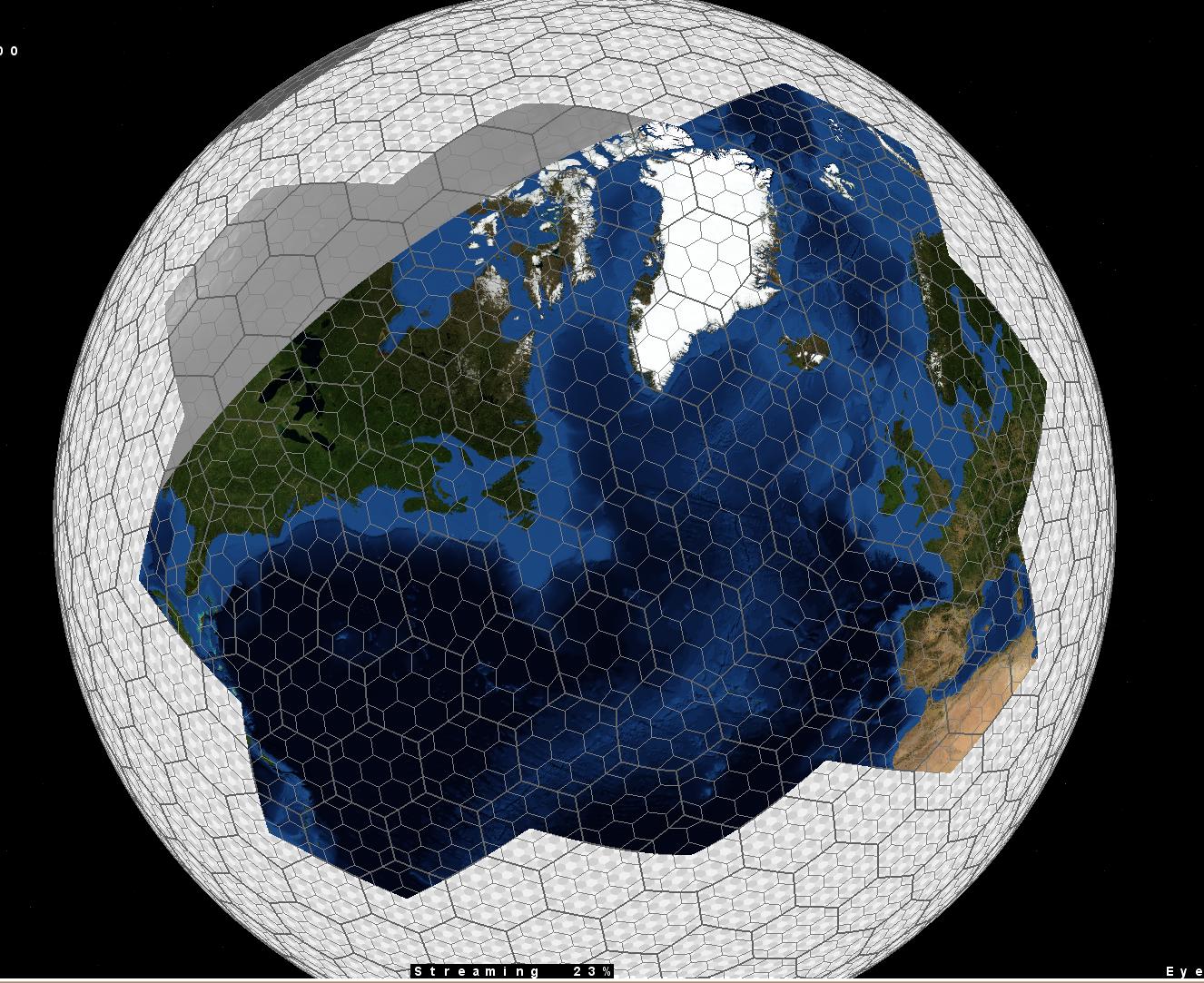
The grid looks a little like this:
My package is based on Kevin Sahr's DGGRID which can generate this same grid to KML directly, though you'll need to figure out how to compile it yourself.