Can a Ford F-150 Stop a C-123 Provider?
Ford ran a commercial showing an F-150 pickup truck stopping a landing C-123 Provider aircraft with a tow chain. Let's see if the physics holds up.
Measuring the Commercial
Tow Chain Angle
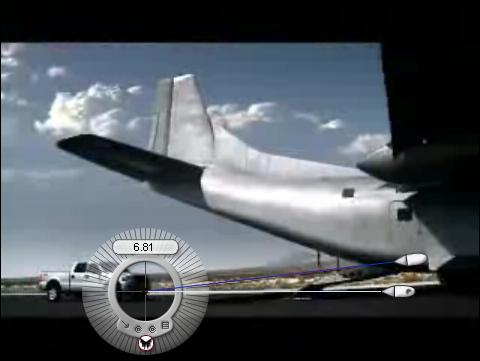
The angle of the tow chain is approximately 6.81 degrees. The camera isn't normal to the plane through which the chain passes, so this is an underestimate.
Deceleration from the Speedometer
The commercial shows the plane's speedometer:
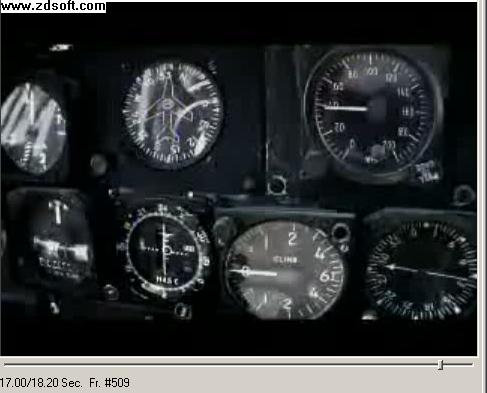
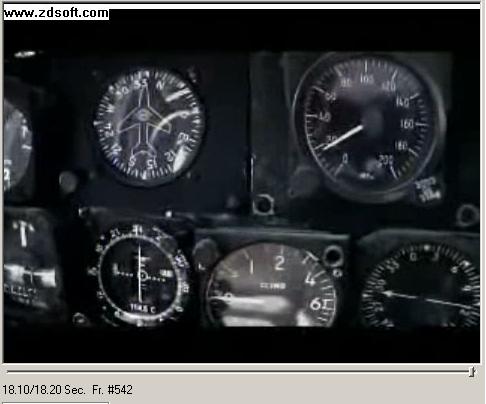
At t=17.00s the plane reads ~38 MPH; at t=18.10s it reads ~17 MPH.
$$a = \frac{(17 - 38)\ \text{MPH}}{(18.1 - 17.0)\ \text{s}} = \frac{-21\ \text{MPH}}{1.1\ \text{s}} \approx -8.53\ \text{m/s}^2$$
Deriving the Physics
Rolling Friction of the Truck
The plane's tires are assumed to have negligible rolling friction. The truck's braking force is:
$$F_f = \mu m g$$
Braking Equations
Simple (horizontal chain):
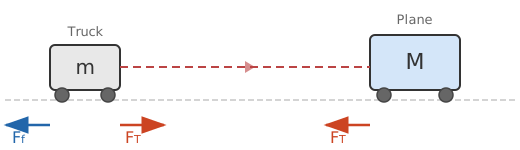
$$F_m = F_f - F_T = ma$$
$$F_M = F_T = Ma$$
$$\therefore\ a = \frac{F_f}{m + M}$$
With chain angle α:
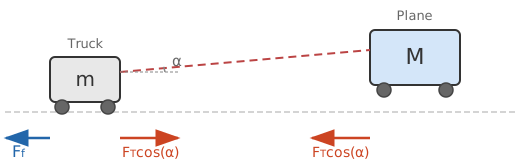
$$F_m = F_f - F_T \cos(\alpha) = ma$$
$$F_M = F_T \cos(\alpha) = Ma$$
$$\therefore\ a = \frac{F_f}{m + M} = \frac{\mu mg}{m + M}$$
The angle drops out. (Note: this is a simplification. The chain's upward pull on the truck slightly reduces its normal force and thus its braking friction. At α = 6.81° the vertical component is sin(6.81°) ≈ 12% of the chain tension, which would reduce the effective friction force somewhat. We ignore this here to keep the analysis tractable and because it only makes the truck less effective — strengthening our conclusion.)
Final Equation
$$a = \frac{\mu mg}{m + M}$$
Known Values
C-123 Provider mass: 16,042 kg
Coefficient of friction: With ABS brakes (static friction) and rubber tires on concrete runway: μ = 1.0 (source)
F-150 curb weights (source):
| Regular Cab | SuperCab | SuperCrew | ||||||||||
|---|---|---|---|---|---|---|---|---|---|---|---|---|
| Engine | 6ft 4x2 | 6ft 4x4 | 8ft 4x2 | 8ft 4x4 | 5ft 4x2 | 5ft 4x4 | 6ft 4x2 | 6ft 4x4 | 8ft 4x2 | 8ft 4x4 | 5ft 4x2 | 5ft 4x4 |
| 4.2L (kg) | 2093 | — | 2153 | — | — | — | — | — | — | — | — | — |
| 4.6L (kg) | 2136 | 2270 | 2195 | 2331 | 2258 | 1949 | 2297 | 2433 | — | — | 2348 | 2484 |
| 5.4L (kg) | 2182 | 2317 | 2243 | 2377 | 2337 | 2473 | 2345 | 2482 | — | — | 2395 | 2530 |
| 5.4L payload (kg) | — | — | 2325 | 2455 | — | — | — | — | 2495 | 2653 | — | — |
Calculated Accelerations (m/s²)
Using $a = \mu mg / (m + M)$ for each truck variant:
| Regular Cab | SuperCab | SuperCrew | ||||||||||
|---|---|---|---|---|---|---|---|---|---|---|---|---|
| Engine | 6ft 4x2 | 6ft 4x4 | 8ft 4x2 | 8ft 4x4 | 5ft 4x2 | 5ft 4x4 | 6ft 4x2 | 6ft 4x4 | 8ft 4x2 | 8ft 4x4 | 5ft 4x2 | 5ft 4x4 |
| 4.2L | 1.13 | — | 1.16 | — | — | — | — | — | — | — | — | — |
| 4.6L | 1.15 | 1.22 | 1.18 | 1.24 | 1.21 | 1.06 | 1.23 | 1.29 | — | — | 1.25 | 1.32 |
| 5.4L | 1.17 | 1.24 | 1.20 | 1.27 | 1.25 | 1.31 | 1.25 | 1.31 | — | — | 1.27 | 1.34 |
| 5.4L payload | — | — | 1.24 | 1.30 | — | — | — | — | 1.32 | 1.39 | — | — |
The maximum calculated deceleration is 1.39 m/s² — about 84% less than the 8.53 m/s² shown in the commercial. At 1.39 m/s², slowing the plane by 21 MPH would take ~6.75s, not 1.1s.
Adding Linear Air Drag
The C-123B Provider is powered by two Pratt & Whitney R-2800-99W radial piston engines rated at 2,300 hp each (source), for a total of 4,600 hp (3,431 kW). At its maximum speed of 367 km/h (101.94 m/s), thrust equals drag. Assuming a propeller efficiency of η = 0.75:
$$F_\text{thrust} = \frac{\eta P}{v_\text{max}} = \frac{0.75 \times 3{,}431{,}000}{101.94} \approx 25{,}250\ \text{N}$$
As a first approximation, model drag as linear: $F_D = bv$, where:
$$b = \frac{F_\text{thrust}}{v_\text{max}} = \frac{25{,}250}{101.94} \approx 247.7\ \mathrm{N{\cdot}s/m}$$
Equation of motion with drag acting on the plane:
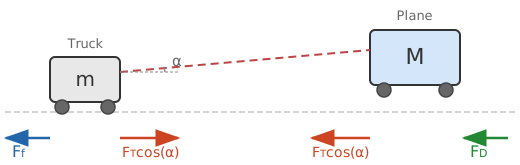
$$a(m + M) = F_f + F_D$$
$$\frac{(m + M),dv}{\mu mg + bv} = dt$$
$$\Delta t = \frac{m + M}{b}\ln!\left(\frac{\mu mg + bv_i}{\mu mg + bv_f}\right)$$
With the heaviest F-150 (m = 2653 kg), M = 16,042 kg, v_i = 16.99 m/s (38 MPH), v_f = 7.60 m/s (17 MPH):
$$\Delta t \approx 6.04\ \text{s}$$
Air drag accounts for an extra ~0.71s over friction alone, but the commercial still shows the braking happening ~4.9s faster than the physics allows.
Adding Quadratic Air Drag
Linear drag is a rough approximation. At aircraft speeds, aerodynamic drag is better modeled as quadratic: $F_D = kv^2$, where $k = \tfrac{1}{2}\rho C_D A$.
We can derive k from the same max-speed equilibrium:
$$k = \frac{F_\text{thrust}}{v_\text{max}^2} = \frac{25{,}250}{101.94^2} \approx 2.43\ \mathrm{N{\cdot}s^2/m^2}$$
The equation of motion becomes:
$$(m + M)\frac{dv}{dt} = -(\mu mg + kv^2)$$
Separating variables and integrating:
$$\Delta t = \frac{m + M}{\sqrt{\mu mg \cdot k}}\left[\arctan!\left(v_i\sqrt{\frac{k}{\mu mg}}\right) - \arctan!\left(v_f\sqrt{\frac{k}{\mu mg}}\right)\right]$$
With the same values as before (m = 2653 kg, M = 16,042 kg, v_i = 16.99 m/s, v_f = 7.60 m/s):
$$\Delta t \approx 6.67\ \text{s}$$
Quadratic drag is slightly more favorable to the truck than linear drag (the drag force at landing speeds is lower), but the difference is small. Either way, the commercial's 1.1s is far from physical reality.
What's Missing
- The plane's propellers are still spinning at landing, counteracting friction and extending stopping time further
- Rolling friction of the plane's tires was ignored (would help the truck slightly)
- The plane was already doing some braking before the commercial shows — it had to be going much faster than 38 MPH at touchdown
- The speedometer dial may not be in MPH
- μ > 1.0 is possible but not typical for rubber-on-concrete
Conclusions
The deceleration shown in the commercial is roughly 6× as large as what the physics supports, even under generous assumptions. Ford's ad is great marketing, bad physics.