How far does a ship coast?
My family went on a cruise last Christmas and we somehow found ourselves discussing how many miles it takes for a cruise boat to come to a stop. The physics on this isn't too bad, so I worked it out over dinner.
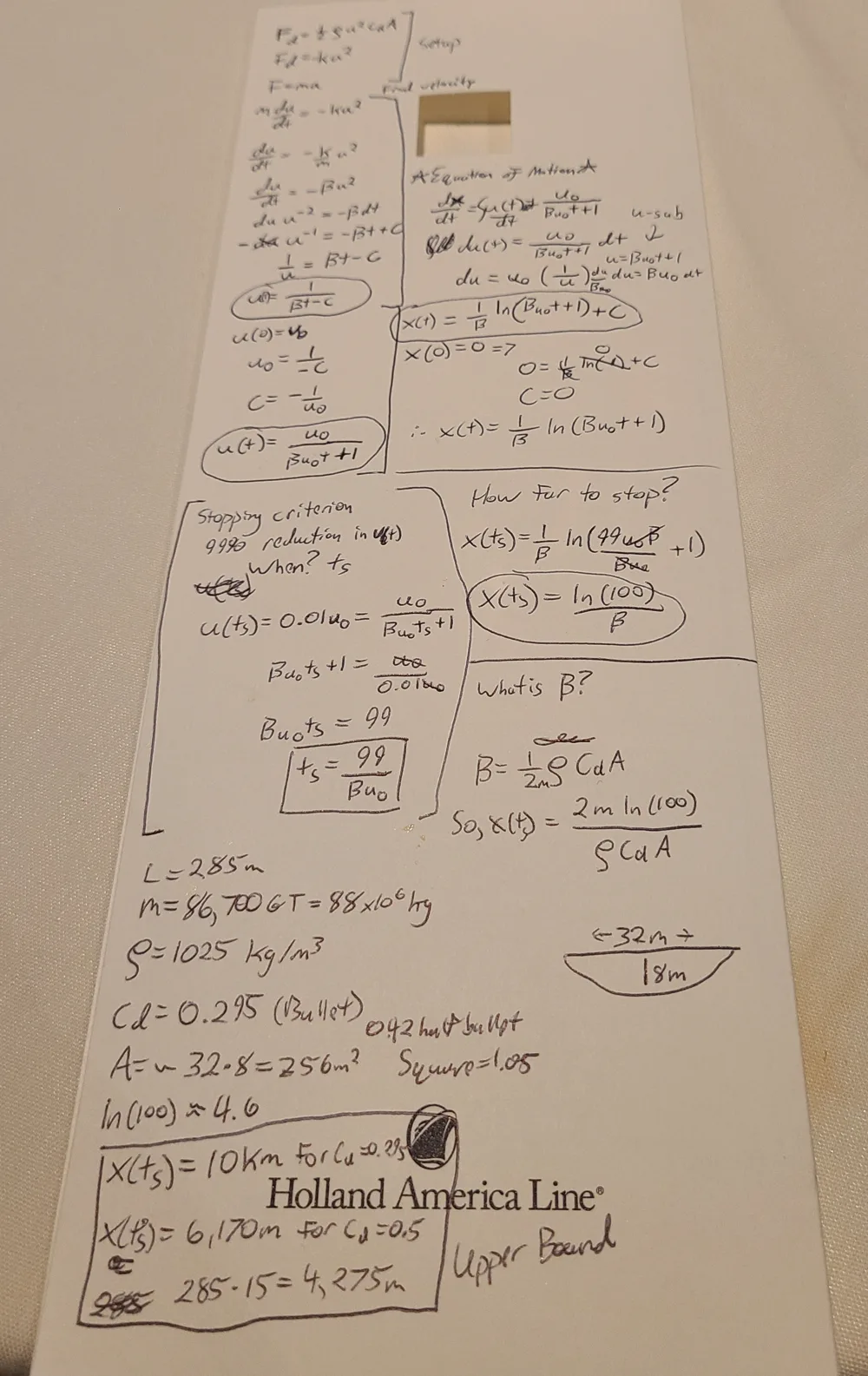
Stopping distance
With the engines off, the only force acting on the ship is drag from the water
$$ F_d = \tfrac{1}{2}\rho v^2 C_d A = k v^2 . $$
where $\rho$ is the density of water, $C_d$ is the drag coefficient, and $A$ is the cross-sectional area. Applying Newton's second law we get
$$ m\frac{dv}{dt} = -k v^2 \quad\Longrightarrow\quad \frac{dv}{dt} = -\beta v^2, \qquad \beta = \frac{k}{m}. $$
separating the variables gives
$$ v^{-2} dv = -\beta dt $$ and we integrate to get $$ -v^{-1} = -\beta t + C \Longrightarrow v = 1/(\beta t - C) $$ with initial speed $v(0) = v_0$, $C = -1/v_0$, so
$$ v(t) = \frac{v_0}{\beta v_0 t + 1}. $$
We integrate again to get position:
$$ \frac{dx}{dt} = v(t) = \frac{v_0}{\beta v_0 t + 1}. $$
using $u = \beta v_0 t + 1$, we have $du = \beta v_0 dt$, and take $\int du/(\beta u)$ to get
$$ x(t) = \frac{1}{\beta}\ln(\beta v_0 t + 1) + C. $$
with $x(0) = 0$ giving $C = 0$.
Since the speed only approaches zero asymptotically, let's take a 99% reduction in speed as our condition for being "stopped". Call the time at which this speed is reached $t_s$, so
$$ v(t_s) = 0.01 v_0 = \frac{v_0}{\beta v_0 t_s + 1} \quad\Longrightarrow\quad \beta v_0 t_s = 99 \quad\Longrightarrow\quad t_s = \frac{99}{\beta v_0}. $$
From this we can get the stopping distance
$$ x(t_s) = \frac{1}{\beta}\ln\left(\beta v_0\frac{99}{\beta v_0} + 1\right) = \frac{\ln 100}{\beta}. $$
And here you can tell that the calculations have gone well because $v_0$ disappears as is the way with these things.
Numerics
Recall
$$ \beta = \frac{\rho C_d A}{2m} $$ therefore $$ x(t_s) = \frac{2m\ln 100}{\rho C_d A} $$
Pulling in some numbers for our Nieuw Amsterdam and a few physical constants, reasonable values are:
- Length $L = 285$ m
- $m$: 86,700 gross tons, which I took as $88\times10^6$ kg
- $\rho = 1025\textrm{ kg/m}^3$ for seawater
- $A \approx 32 \times 8 = 256\textrm{ m}^2$, the beam times the draft
- $C_d$: 0.295 for a bullet shape, 0.42 for a half-bullet, 1.05 for a square face
- $\ln 100 \approx 4.6$
So the distance to lose 99% of the speed is:
- $C_d = 0.295$ (bullet): $x(t_s) \approx$ 10,470 m
- $C_d = 0.5$: $x(t_s) \approx$ 6,180 m
IMO's manoeuvrability standards require a ship to stop within 15 ship lengths with its engine full astern. For Nieuw Amsterdam this is $285 \times 15 =$ 4,275 m.
Refining the calculations
I didn't have an engine power figure available at sea, but back on land I do and it's possible to refine the above calculations using it. To maintain constant forward speed the ship's engine has to supply power equal to drag.
$$ P = F_d v = \tfrac{1}{2}\rho C_d A v^3 \quad\Longrightarrow\quad C_d A = \frac{2P}{\rho v^3}. $$
Nieuw Amsterdam uses two motors rated at 17.6 MW each, for a total of 35.2 MW, and it has a cruising speed of 21.8 knots (11.2 m/s). So
$$ C_d A \le \frac{2(35.2\times 10^6)}{(1025)(11.21)^3} \approx 48.7\textrm{ m}^2 $$
This gives a stopping distance of $x(t_s) = 2m\ln 100/(\rho C_d A) \approx$ 16.2 km.
This is an upper bound on the actual drag since the engines likely aren't running at max when the ship is at cruising speed and there are efficiency losses.
Summary of final estimates
| Scenario | Stopping Time | Stopping Distance |
|---|---|---|
| $C_d = 0.295$ (bullet) | 5.6 h | 10.5 km |
| $C_d = 0.5$ | 3.3 h | 6.2 km |
| Engine power, $C_d A = 48.7\textrm{ m}^2$ | 8.6 h | 16.2 km |
| IMO limit, engine full astern (15 ship lengths) | ≤ 4.3 km |
Here, "stopping time" means the time it takes the ship to slow from 21.8 knots to 1% of that speed. Distances are independent of the starting speed.